ugh
papers due, take home exams (i'd much rather sit in class and sweat through 2 hours of an exam than have a take home) and i lack the motivation.
im currently writing about the 7th august 1998 bombing of the u.s embassy in nairobi for a class...This year is the 10th anniversary, and it's amazing how much i remember from that day- i almost just want to write about my experience- instead of evaluating the mental and psychosocial response.
here's my intro (yes, im sneaking in what i really want to write about- but this is the slightly fleshed out version). it reads a bit discordant.
August 1998 remains a salient month in a majority of Kenyans memories.
On August 7th, (3 days before my birthday) the U.S Embassy was bombed, with a simultaneous bombing occurring in Dar-es-salaam, Tanzania. This was the first large-scale disaster to happen in our memory, and like most Kenyans, I can vividly recollect where I was, and what I was doing. At the time I was working with the Regional AIDS Training Network (RATN), which ran training courses for providers of HIV/AIDS services in eastern and southern Africa. (First job, poorly paid, big title.)
I remember that month as one in which there was great tension on the streets of Nairobi. The Kenya National Union of Teachers (K-NUT)was threatening to go on strike over government failure to implement a pay rise they had previously agreed on; a strike the government had declared illegal, threatening to fire teachers who did not report to work.
Bank workers were on strike, protesting a raise in taxes, and they too were were threatened with the sack. City council workers, over 15 thousand of them, in an effort not to be left behind, downed their tools as well: they had not been paid for several months, and were busy having running battles with riot police on the streets of Nairobi, while garbage remained uncollected.
Every evening, the acrid smell of tear gas enveloped the streets.
It was also the month in which the World Bank and IMF, and several international investors had suspended funding projects in Kenya.
On top of that, it would take me more than 3 hours to get home most evenings, because of having to wait in long lines to get into a matatu- and where i lived (Tena estate) matatus were scarce, old, ramshackled, and overpriced. Masaai's, controlled our route- hence matatu owners had to pay them daily to be allowed to operate their vehicles (i think it was still Maasai's- the mungiki were still fairly nascient, i believe- i could be wrong)
There was just a general premonition that something was in the air (something was afoot).
That morning, I remember there was a loud boom! and then total silence.
We turned on the radio and all you could hear was static... and dead silence…
my first thought was 'ohmygod there has been a coup'- there had been rumours going round- and how was i going to get home- and somebody call my mother...and being scared shitless.
Then there was the wailing of police sirens and ambulances- RATN was housed in one of the buildings on the compound of Kenyatta National Hospital, the largest public hospital in Kenya. The radio abruptly started reporting that an attack had happened at the American embassy site.... calls for blood donations...kenyans covered under rubble... calls for volunteers..cooperative house about to crumble...more calls for volunteers... I had to go to Kenyatta.
It was only until a few of us went to the wards of the hospital and saw the many people wounded laying on the floor of the hospital, in their blood and that of others, -the bed capacity of the hospital was already overstretched -did the full scale of the what had transpired register. I dont know how many hours i was at Kenyatta... at some point they were turning away volunteers because so many Kenyans had showed up to help...I dont remember how i got home.
The next couple of days... watching the rescue efforts, hearing about people still trapped under the rabble...watching kenyans valiantly working day and night to rescue those trapped, americans refusing people access to the embassy site even though some kenyans were still trapped.... and the Israeli's coming in to help- and doing a whole lot more than the americans.. It was a tragedy, but one that brought us together nonetheless.
--
Wahome Mutahi (aka Whispers- *pours a frothy beverage in his honour*-may he rest in peace- sorely missed) wrote an excellent book about this: Doomsday, which, even though a fictionalized account- captures the mood of the country as only Mutahi can.
I love Kenya, and Kenyans. Even though i get frustrated at our politics and policians, and i still cant make sense of the recent elections fiasco... i am excited at the possibility of being in Nairobi in the next few weeks. No other city quite captures the feel of nairobi. i cant hardly wait to speak swahili, have a tusker, and just chill with friends. I cant wait to be in the CBD at rush hour, amazed at the mass of black bodies -yes nairobi is overpopulated- rushing to get home- or wherever. I got over saying that im boycotting the country because im ashamed at them trying to flush it down the toilet- im over that sentiment. Right now? i cant wait to land at JKIA and have the customs person (its almost always a lady) greet me with: naona imekuwa siku nyingi, karibu nyumbani
Monday, April 28, 2008

Saturday, April 26, 2008
Aimé Fernand Césaire: Tribute to a literary monument
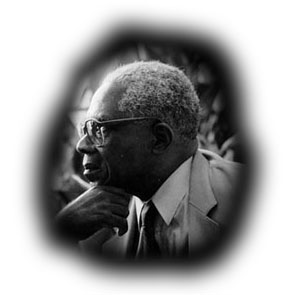
*pours a likkle likka for negritude*
nb: as someone noted:
>In the United States, poets Langston Hughes and Claude Mackay
>emulated Césaire’s proclamation of African values as they
>endured white racism.
This gets the main flow of influence backwards (even if it was ultimately a two-way street).
----------
http://www.nationmedia.com/dailynation/nmgcontententry.asp?category_id=39&newsid=121540
Story by F.K. IRAKI
Publication Date: 4/20/2008
When Jomo Kenyatta penned Facing Mount Kenya in 1938, he was reacting like many Black intellectuals of the time to British and French cultural imperialism.
The logic of the imperialists was simple: The African has no history, and is therefore devoid of a culture. The only God-ordained pathway available was to colonise him, give him a history, a god and a culture. This was the rationale behind slavery in the 16th century and colonialism in the 19th century.
Aimé Césaire, born in Basse-Pointe in Martinique on 25 June 1913, published the book-length poem Cahier d’un retour au pays natal (Notes on a Return To A Native Land) in 1939 as a reaction to French assimilatory cultural tendencies which tended to negate the very existence of Africans.
Placed on an evolutionary scale, the African could rise from a primitive, unlettered state to become an évolué (evolved person), i.e. a Frenchman. This was cultural assimilation.
On a lighter note, African schoolchildren in French West Africa sang their hearts out to Nos ancêtres les Gaulois (Our Ancestors the Gauls) to celebrate their common ancestry with the French nationals.
In his collection of poems, Césaire sought to affirm the existence of a vibrant Black culture and instill respect for Black values by the overpowering Europeans. Like Kenyatta, he pulled no punches in reminding the West that Africans had their own history and culture and needed no lessons from Europeans.
Césaire’s writings, including Discours sur le colonialism (Discourse on Colonialism), are emblematic of the Black man’s predicament in terms of identity in a world that constantly threatens to negate his existence.
The term Negritude was first coined by Césaire to denote “the consciousness of being black.” It was a “positive assertion of African cultural values” despite negation and annihilation by Western imperialists.
Césaire’s influence was far-reaching. Leopold Sédar Senghor, Africa’s leading poet and first president of Senegal, joined Césaire in Paris in 1934 and with yet another maestro of poetry, Leon Damas, founded the literary review L’étudiant Noir (Black Student).
Negritude, tigritude
The review, peppered with communist propaganda, was instrumental in publishing articles from Black intellectuals that acclaimed the values of Negritude. There was no longer any need for Africans to deny their history and assert that they, too, were descended from the Gauls.
In the United States, poets Langston Hughes and Claude Mackay emulated Césaire’s proclamation of African values as they endured white racism.
In poignant poems on African resilience and valour, these poets gave a new twist to the term ‘negro’ that had been associated with primitivism and tabula rasa (blank mind and soul). The term came to assume a new majesty that reaffirmed the greatness of African people in the Africa and in the diaspora.
Césaire, the brilliant young man who was taught to read and write French by his grandmother, Eugénie, rose to become an icon in the fight against racism and colonialism. Frantz Fanon, the author of Black Skins White Masks and The Wretched of the Earth, was one of the intellectual disciples of Césaire.
Fanon succinctly captures the psychological harm that colonisation does to both master and slave. They both become dehumanised in the dialectic.
Once freed, the slave will try to be like his master for the simple reason that the master is the only image he understands. He has internalised the process of dehumanisation.
In 1947, Césaire, Senghor and Alioune Diop founded Présence Africaine, a review that published works of most Francophone Africa’s illustrious writers. These include Camara Laye’s African Child, Ousmane Sembène’s Xala and God’s Bits of Wood, just to mention a few. But Negritude as a philosophy or literary movement is not without its detractors.
Anglophone writers were not sympathetic to the Negritude authors whom they perceived to be dancing to their master’s tune.
Chinua Achebe, while producing the eternal Things Fall Apart, does not pretend to be sanitising African values like we find in Laye’s African Child. Rather, he brings out the African ethos both in a positive and negative light.
Similarly, Wole Soyinka rebukes the Negritude authors, saying “a tiger does not shout its tigritude; it acts.”
The intellectual cleavage between African Anglophones and Francophones is rooted in the colonial administration of Africa. While the French were assimilationist, the British preferred indirect administration where the African was basically left to his own devices as an inferior being.
Césaire studied at the Ecole Normale Supérieure (1935-1939) in Paris before proceeding to the Sorbonne where he obtained a bachelor of arts degree in literature.
Cultural absorption
Like Senghor, he was in favour of the idea of France maintaining her political control over African people but resented cultural absorption. Senghor rose to join the ranks of les Immortels (the Immortals) when he was admitted into the prestigious Academie Française, the body of eminent French people who regulate the French language.
Senghor’s distinction underscores the French colonial reality that still plays out in Francophone Africa. France still plays a significant role in the affairs of many West African states, and some French presidents have been godfathers to the sons of some African presidents.
Despite criticism of his philosophical ideas, Césaire remains head and shoulders above most of the continent’s intellectual figures.
He enjoys pride of place among literary and philosophical giants.
When he passed away on April 17 at the age of 94 in an infirmary in Fort-de-France, Martinique, many felt that a prophet had left them. One admirer described his death as the “crumbling of a literary monument”.
With all their accolades and world prizes, Césaire’s works remain a constant reminder of the need to assert our identity as Africans. Without a culture, we are a dead people.
Frederick K. Iraki is an associate professor of French Linguistics at USIU.
We must be vigilant about writing our own history/Algeria
i say this often, and when i forget something comes along and reminds me why this is important
yesterday i went to the tribeca film festival and watched: Algeria, Unspoken Stories with some friends
with the expectation that its a realistic depiction of the algerian civil war
anyway, the film was from the point of view of french algierians.
who absolutely could not understand why 'they'- algerians- would want to get rid of us, we did so much for this country
very much the white man's burden mentality.
very much the colonialists interpretation of colonialism having been good for the natives
there was an interesting segment in which the film maker interviews a french-algerian who was part of the independence movement
and who was giving the point of view of the resistance movement
and why it was necessary, and the film maker basically gets into a back and forth
argument with her.... calling it a terrorist movement, and why did they kill innocent french civilians
totally failing to mention the number of innocent algerians who were killed and tortured by the french.
during Q&A- it was amazing to watch the reaction of algerians- angry and for a reason.
he was asked if there was so much intermixing between french and arabs, why were there such few intermarriages to which he responded: moslem culture does not allow moslem women to marry outside their ethnic group- but it is not the case for moslem men- something which they took full advantage of.
----
i thought this blog entry was interesting:
http://redredbecca.blogspot.com/2008/04/tff-day-two-algeria-unspoken-stories.html
TFF Day Two: Algeria, Unspoken Stories - another "Gone with the Wind?"
Perhaps it's extreme to compare Jean-Pierre Lledo's, Algeria: Unspoken Stories to that mythic version of the Civil War and the Reconstruction, but by the time the film was over, it really did feel like the French-Algerian (Pied Noir) version of "Moonlight and Magnolias."
The film followed four different Algerians from different mixed-ethnicity neighborhoods as they recalled their experiences during the war of independence and immediately after. The focus of the film was on the massacres of Europeans in the immediate aftermath of independence and the killing of the non-Muslim Arabs, called "Gours." The first half of the 2 hour + 45 minute film was interesting. Lledo's first subject was a farmer named Aziz, a "gour" whose family was killed by Algerian resistance fighters (?) in 1955.
His second was a woman named Katilba, a Muslim Arab from a mostly Jewish and Christian neighborhood called Bab El-Oued, who had left there for the Casbah during the war of independence, but since the 1990s cannot return to either place. Hers was the best segment of the film, and featured a defense of revolutionary violence by her and a woman resistance fighter.
The second half of the film degenerated significantly from there. The failure to edit the film effectively really began to take its toll in the third segment followed a man in Constantine who refused to be identified and therefore was covered by a black square throughout. His section concerned a Jewish Andalusian singer named "Cheikh Raymond" (look here too) who had been assassinated in 1961. Because of the blacked-out main "character" this part of the film was utterly confusing and not at all engaging.
In the final segment Lledo turned the interviewing over to a young playwright enchanted with Albert Camus, who interviewed residents of the formerly Spanish neighborhood in Oran where a massacre of Europeans followed independence on July 5, 1962. The film reached its nadir when Tchitchi, an Arab who was a popular fixture in Spanish dance-halls referred to the time prior to independence as when the people were "happy" and got along.
While the film-maker wrung his hands over the deaths and exile of Europeans following independence, the numbers of Algerian dead during the war - anywhere from 350,000 to 1 million- were not mentioned at all. The violence perpetrated by the French is only mentioned in fragmentary comments. There was no exposition in the film, making it problematic for anyone but an Algerian audience.
Speakers referred to "gours," Pieds-Noirs," and the OAS, and none of these were explained in any detail. The Islamic terror of the 1990s was mentioned over and over again, but was not explained either. As one outraged Algerian audience member reminded the rest of us during the Q&A, how was it that everyone got along in these neighborhoods when Muslim Arabs were segregated in contrast to Jews and Christians who had full citizenship?
As another (Algerian?) man pointed out, the whole thing could be misleading for anyone who didn't know the history of French colonialism in Algeria. One of my favorite things about seeing films at this festival is that at every screening of a foreign film that I've gone to has an audience of people from the country in question who have interesting comments and questions afterward.
As my companion at the the film argued later, the most interesting part of the film- the interview with the female Algerian resistance fighter - was largely wasted. Instead of arguing with her about whether violence against civilians is ever justified, I wished that Lledo had asked her about gender politics in Algeria after the revolution. Neither she nor Katilba wore the hijab and both seem quite Westernized.
I was interested to see that Lledo had made a previous film with Henri Alleg, and despite my problems with this film, I thought of trying to see his more Algerian, Algerian Dream, but then I read the review linked above which describes it as an "interminable home movie," I've decided I can give it a miss. After seeing Peter Scarlet kvell over two post-revolutionary films (the Forgacs film in the '05 festival that practically took the Fascist side in the Spanish Civil War) and one impossibly bad Brazilian feature at the fest in '06, I think I'll be wary of his recommendations in the future.
yesterday i went to the tribeca film festival and watched: Algeria, Unspoken Stories with some friends
with the expectation that its a realistic depiction of the algerian civil war
anyway, the film was from the point of view of french algierians.
who absolutely could not understand why 'they'- algerians- would want to get rid of us, we did so much for this country
very much the white man's burden mentality.
very much the colonialists interpretation of colonialism having been good for the natives
there was an interesting segment in which the film maker interviews a french-algerian who was part of the independence movement
and who was giving the point of view of the resistance movement
and why it was necessary, and the film maker basically gets into a back and forth
argument with her.... calling it a terrorist movement, and why did they kill innocent french civilians
totally failing to mention the number of innocent algerians who were killed and tortured by the french.
during Q&A- it was amazing to watch the reaction of algerians- angry and for a reason.
he was asked if there was so much intermixing between french and arabs, why were there such few intermarriages to which he responded: moslem culture does not allow moslem women to marry outside their ethnic group- but it is not the case for moslem men- something which they took full advantage of.
----
i thought this blog entry was interesting:
http://redredbecca.blogspot.com/2008/04/tff-day-two-algeria-unspoken-stories.html
TFF Day Two: Algeria, Unspoken Stories - another "Gone with the Wind?"
Perhaps it's extreme to compare Jean-Pierre Lledo's, Algeria: Unspoken Stories to that mythic version of the Civil War and the Reconstruction, but by the time the film was over, it really did feel like the French-Algerian (Pied Noir) version of "Moonlight and Magnolias."
The film followed four different Algerians from different mixed-ethnicity neighborhoods as they recalled their experiences during the war of independence and immediately after. The focus of the film was on the massacres of Europeans in the immediate aftermath of independence and the killing of the non-Muslim Arabs, called "Gours." The first half of the 2 hour + 45 minute film was interesting. Lledo's first subject was a farmer named Aziz, a "gour" whose family was killed by Algerian resistance fighters (?) in 1955.
His second was a woman named Katilba, a Muslim Arab from a mostly Jewish and Christian neighborhood called Bab El-Oued, who had left there for the Casbah during the war of independence, but since the 1990s cannot return to either place. Hers was the best segment of the film, and featured a defense of revolutionary violence by her and a woman resistance fighter.
The second half of the film degenerated significantly from there. The failure to edit the film effectively really began to take its toll in the third segment followed a man in Constantine who refused to be identified and therefore was covered by a black square throughout. His section concerned a Jewish Andalusian singer named "Cheikh Raymond" (look here too) who had been assassinated in 1961. Because of the blacked-out main "character" this part of the film was utterly confusing and not at all engaging.
In the final segment Lledo turned the interviewing over to a young playwright enchanted with Albert Camus, who interviewed residents of the formerly Spanish neighborhood in Oran where a massacre of Europeans followed independence on July 5, 1962. The film reached its nadir when Tchitchi, an Arab who was a popular fixture in Spanish dance-halls referred to the time prior to independence as when the people were "happy" and got along.
While the film-maker wrung his hands over the deaths and exile of Europeans following independence, the numbers of Algerian dead during the war - anywhere from 350,000 to 1 million- were not mentioned at all. The violence perpetrated by the French is only mentioned in fragmentary comments. There was no exposition in the film, making it problematic for anyone but an Algerian audience.
Speakers referred to "gours," Pieds-Noirs," and the OAS, and none of these were explained in any detail. The Islamic terror of the 1990s was mentioned over and over again, but was not explained either. As one outraged Algerian audience member reminded the rest of us during the Q&A, how was it that everyone got along in these neighborhoods when Muslim Arabs were segregated in contrast to Jews and Christians who had full citizenship?
As another (Algerian?) man pointed out, the whole thing could be misleading for anyone who didn't know the history of French colonialism in Algeria. One of my favorite things about seeing films at this festival is that at every screening of a foreign film that I've gone to has an audience of people from the country in question who have interesting comments and questions afterward.
As my companion at the the film argued later, the most interesting part of the film- the interview with the female Algerian resistance fighter - was largely wasted. Instead of arguing with her about whether violence against civilians is ever justified, I wished that Lledo had asked her about gender politics in Algeria after the revolution. Neither she nor Katilba wore the hijab and both seem quite Westernized.
I was interested to see that Lledo had made a previous film with Henri Alleg, and despite my problems with this film, I thought of trying to see his more Algerian, Algerian Dream, but then I read the review linked above which describes it as an "interminable home movie," I've decided I can give it a miss. After seeing Peter Scarlet kvell over two post-revolutionary films (the Forgacs film in the '05 festival that practically took the Fascist side in the Spanish Civil War) and one impossibly bad Brazilian feature at the fest in '06, I think I'll be wary of his recommendations in the future.
Subscribe to:
Posts (Atom)