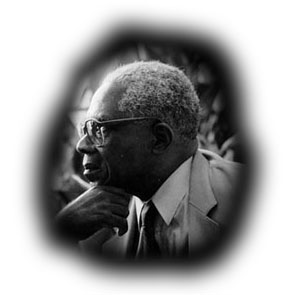
*pours a likkle likka for negritude*
nb: as someone noted:
>In the United States, poets Langston Hughes and Claude Mackay
>emulated Césaire’s proclamation of African values as they
>endured white racism.
This gets the main flow of influence backwards (even if it was ultimately a two-way street).
----------
http://www.nationmedia.com/dailynation/nmgcontententry.asp?category_id=39&newsid=121540
Story by F.K. IRAKI
Publication Date: 4/20/2008
When Jomo Kenyatta penned Facing Mount Kenya in 1938, he was reacting like many Black intellectuals of the time to British and French cultural imperialism.
The logic of the imperialists was simple: The African has no history, and is therefore devoid of a culture. The only God-ordained pathway available was to colonise him, give him a history, a god and a culture. This was the rationale behind slavery in the 16th century and colonialism in the 19th century.
Aimé Césaire, born in Basse-Pointe in Martinique on 25 June 1913, published the book-length poem Cahier d’un retour au pays natal (Notes on a Return To A Native Land) in 1939 as a reaction to French assimilatory cultural tendencies which tended to negate the very existence of Africans.
Placed on an evolutionary scale, the African could rise from a primitive, unlettered state to become an évolué (evolved person), i.e. a Frenchman. This was cultural assimilation.
On a lighter note, African schoolchildren in French West Africa sang their hearts out to Nos ancêtres les Gaulois (Our Ancestors the Gauls) to celebrate their common ancestry with the French nationals.
In his collection of poems, Césaire sought to affirm the existence of a vibrant Black culture and instill respect for Black values by the overpowering Europeans. Like Kenyatta, he pulled no punches in reminding the West that Africans had their own history and culture and needed no lessons from Europeans.
Césaire’s writings, including Discours sur le colonialism (Discourse on Colonialism), are emblematic of the Black man’s predicament in terms of identity in a world that constantly threatens to negate his existence.
The term Negritude was first coined by Césaire to denote “the consciousness of being black.” It was a “positive assertion of African cultural values” despite negation and annihilation by Western imperialists.
Césaire’s influence was far-reaching. Leopold Sédar Senghor, Africa’s leading poet and first president of Senegal, joined Césaire in Paris in 1934 and with yet another maestro of poetry, Leon Damas, founded the literary review L’étudiant Noir (Black Student).
Negritude, tigritude
The review, peppered with communist propaganda, was instrumental in publishing articles from Black intellectuals that acclaimed the values of Negritude. There was no longer any need for Africans to deny their history and assert that they, too, were descended from the Gauls.
In the United States, poets Langston Hughes and Claude Mackay emulated Césaire’s proclamation of African values as they endured white racism.
In poignant poems on African resilience and valour, these poets gave a new twist to the term ‘negro’ that had been associated with primitivism and tabula rasa (blank mind and soul). The term came to assume a new majesty that reaffirmed the greatness of African people in the Africa and in the diaspora.
Césaire, the brilliant young man who was taught to read and write French by his grandmother, Eugénie, rose to become an icon in the fight against racism and colonialism. Frantz Fanon, the author of Black Skins White Masks and The Wretched of the Earth, was one of the intellectual disciples of Césaire.
Fanon succinctly captures the psychological harm that colonisation does to both master and slave. They both become dehumanised in the dialectic.
Once freed, the slave will try to be like his master for the simple reason that the master is the only image he understands. He has internalised the process of dehumanisation.
In 1947, Césaire, Senghor and Alioune Diop founded Présence Africaine, a review that published works of most Francophone Africa’s illustrious writers. These include Camara Laye’s African Child, Ousmane Sembène’s Xala and God’s Bits of Wood, just to mention a few. But Negritude as a philosophy or literary movement is not without its detractors.
Anglophone writers were not sympathetic to the Negritude authors whom they perceived to be dancing to their master’s tune.
Chinua Achebe, while producing the eternal Things Fall Apart, does not pretend to be sanitising African values like we find in Laye’s African Child. Rather, he brings out the African ethos both in a positive and negative light.
Similarly, Wole Soyinka rebukes the Negritude authors, saying “a tiger does not shout its tigritude; it acts.”
The intellectual cleavage between African Anglophones and Francophones is rooted in the colonial administration of Africa. While the French were assimilationist, the British preferred indirect administration where the African was basically left to his own devices as an inferior being.
Césaire studied at the Ecole Normale Supérieure (1935-1939) in Paris before proceeding to the Sorbonne where he obtained a bachelor of arts degree in literature.
Cultural absorption
Like Senghor, he was in favour of the idea of France maintaining her political control over African people but resented cultural absorption. Senghor rose to join the ranks of les Immortels (the Immortals) when he was admitted into the prestigious Academie Française, the body of eminent French people who regulate the French language.
Senghor’s distinction underscores the French colonial reality that still plays out in Francophone Africa. France still plays a significant role in the affairs of many West African states, and some French presidents have been godfathers to the sons of some African presidents.
Despite criticism of his philosophical ideas, Césaire remains head and shoulders above most of the continent’s intellectual figures.
He enjoys pride of place among literary and philosophical giants.
When he passed away on April 17 at the age of 94 in an infirmary in Fort-de-France, Martinique, many felt that a prophet had left them. One admirer described his death as the “crumbling of a literary monument”.
With all their accolades and world prizes, Césaire’s works remain a constant reminder of the need to assert our identity as Africans. Without a culture, we are a dead people.
Frederick K. Iraki is an associate professor of French Linguistics at USIU.

No comments:
Post a Comment